







Corporate Governance
Challenges and Commitments
Under economic volatility, various risks may arise that may impact GGC’s business operations, such as financial risks, legal changes, the transition toward a low-carbon economy, political tensions, and geopolitical uncertainties, all of which could cause business disruptions.
Good Corporate Governance is regarded as the cornerstone of GGC’s operations, helping to prevent and mitigate conflicts of interest and reducing the potential loss of confidence among shareholders and stakeholders. Therefore, to mitigate these risks, GGC is committed to becoming a leader in the oleochemical business with strong Corporate Governance, coupled with operational excellence, while consistently taking into account all Stakeholders across all sectors.
Key Stakeholders

Shareholder, Investor and Analyst

Customer

Government

Supplier and Business Partner

Community
Goals
continuous membership in the Coalition Against Corruption (CAC) of the Thai Private Sector.


Key Performance in 2025

Management Approach
Sustainable Corporate Governance GRI 2-10 (2021), GRI 2-12 (2021), GRI 2-13 (2021), GRI 2-15 (2021), GRI 2-19 (2021), GRI 2-20 (2021)
GGC has established a Good Corporate Governance Policy as a guideline for conducting business in accordance with Corporate Governance principles. This policy aligns with the Principles of Good Corporate Governance for Listed Companies 2017 (CG Code) of the Securities and Exchange Commission (SEC), as well as international frameworks such as the S&P Global Corporate Sustainability Assessment (CSA). The policy defines guidelines for the Board of Directors, executives, and all Employees to apply in their work with transparency and accountability. It encompasses five key principles:
Shareholders’ Rights

Equal Treatment of Shareholders

Responsibilities to Stakeholders

Disclosure of Information and Transparency

Responsibilities of the Board of Directors

GGC also recognizes the importance of Board diversity and has therefore established a Board Diversity Policy, covering dimensions such as gender diversity—considering the proportion of independent directors and female directors—as well as diversity in ethnicity and nationality. The policy also emphasizes a variety of skills, expertise, and sector-specific experience aligned with GGC’s business operations, free from any restrictions or discrimination based on gender, race, nationality, skin color, ethnicity, or religion. GGC also considers candidates from the Director’s Pool of the State Enterprise Policy Office (SEPO) and the Thai Institute of Directors Association (IOD) to promote diversity and suitability in the selection of Board members, ensuring responsiveness to GGC’s strategic plans and long-term objectives.
Governance, Risk Management and Compliance: GRC Committee
GGC has established the GRC Committee and the GRC Working Team to oversee and take responsibility for Corporate Governance, Risk Management, and Compliance operations. The purpose is to ensure that executives, Employees, and GGC operate in accordance with applicable laws and relevant regulations, while aligning with international standards. This structure also enhances effectiveness in planning, review processes, enterprise-level internal controls, and risk assessments through regular monitoring and performance evaluation. These measures help strengthen confidence among shareholders and other Stakeholders, while reducing potential risks and impacts arising from economic, social, and environmental uncertainties.
GRC Committee
The GRC Committee is responsible for reviewing and providing recommendations on the plans, scope, direction, and processes related to GRC operations. These must comply with the Good Corporate Governance Policy, Risk Management, and Internal Control practices, as well as align with the Good Corporate Governance and Business Code of Conduct Handbook and GGC’s strategies. The Committee also supports the integration of GRC operations as part of the organizational culture to maximize benefits for GGC.

Managing Director

Corporate Affairs and Corporate Secretary

Corporate Strategy and Sustainability

Corporate Legal

Internal Audit
GRC Working Team
The GRC working Team is responsible for developing plans, analysing, and evaluating GRC-related data to implement practical actions that maximize benefits to GGC.

Corporate Governance, Compliance and Corporate Secretary

Corporate Legal and Counseling

Corporate Risk Management and Internal Control
GRC Strategy
GGC has established the GRC operational strategy to drive strategic direction and business performance toward the corporate goals while ensuring alignment with international principles. This approach also enhances Stakeholder confidence and improves internal operational efficiency.
| GRC Awareness | GGC raises GRC Awareness and Understanding among Employees across the organization by implementing a Tone from the Top approach, where organizational leaders lead by example in applying GRC policies with rigor in day-to-day operations, helping drive Employees to follow the guidelines. Communication is also conducted through various channels, including internal memos, messages from the Managing Director, declarations from senior executives, speeches delivered by department heads at meetings, and statements published in the Sustainability Report or other related reports. |
| GRC Framework |
In promoting values through various organizational processes to embed the GRC culture sustainably, GGC has implemented the following actions:
|
| Performance Monitoring |
GGC applies technology to enhance operational agility, speed, and security, as follows:
|
GRC Roadmap 2025-2026
GGC aims to continuously advance its GRC operations to enhance internal efficiency while ensuring full integration of Governance, Risk Management & Internal Control, and Compliance across the organization. This integrated approach strengthens Stakeholder confidence and supports sustainable and effective organizational management.
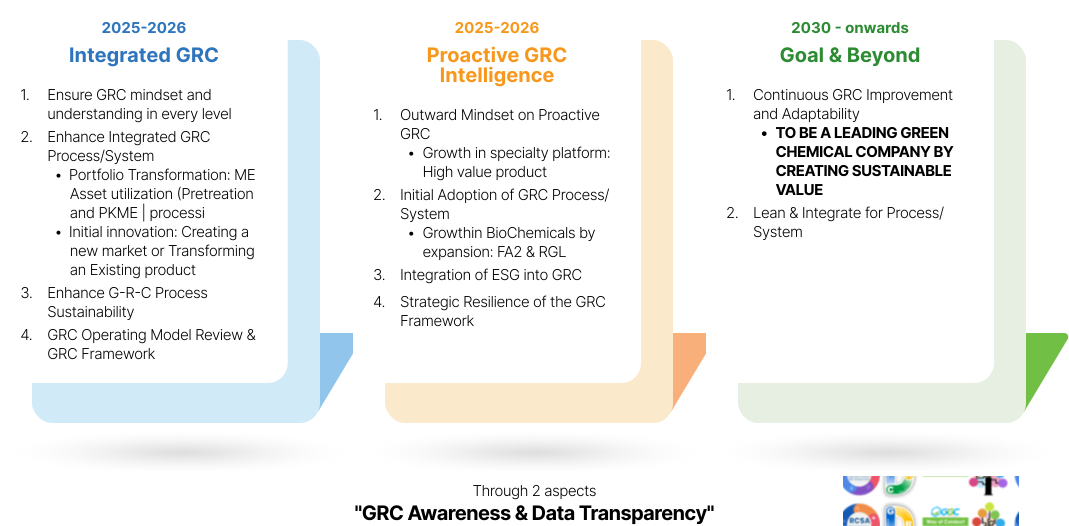
| Operation 2025 |
1. Ensuring GRC Mindset and Understanding for All Levels
2. Enhancing Integrated GRC Process and System
3. Enhancing G–R–C Process Sustainability
4. GRC Operating Model Review and GRC Framework Development
|
| Operation 2026 |
GGC has established four core focus areas for GRC implementation in 2026: 1. Enhancing GRC Confidence Promoting GRC awareness and understanding across all Employee levels through multi-channel communication, supported by assessments such as tests and the GRC Health Check to ensure GRC principles are fully integrated into workflows and the organizational culture. 2. Integrating GRC into Systems and Work Processes Encouraging all units to apply GRC principles in their operations to reduce redundancy and enhance efficiency, supporting business restructuring and the development of work processes aligned with corporate strategy. 3. Advancing Sustainable GRC Operations Continuously improving Governance, Risk Management, and Internal Control systems, strengthening RCSA practices, and enhancing Compliance and Contract Management to ensure structured and effective operations. 4. Reviewing and Strengthening the GRC Operating Model Reviewing the effectiveness of GRC implementation, modernizing operational processes, expanding GRC application to cover all units, and developing the GRC framework in alignment with SEC, IOD, and OCEG standards. Evaluation results will be reported to senior management to support continuous improvement. |
Board of Directors GRI 2-17 (2021)
Currently, the structure of the Board of Directors of GGC comprises 11 members, including 1 female director and 6 independent directors, all of whom possess diverse knowledge, capabilities, and expertise. GGC has also appointed four Board Committees, namely the Audit Committee, the Nomination and Remuneration Committee, the Corporate Governance and Sustainable Development Committee, and the Risk Management Committee. GGC has established a requirement that each director of GGC may hold directorships in no more than five companies listed on the Stock Exchange of Thailand, to ensure that directors can effectively dedicate sufficient time and attention to the oversight and management of GGC.

Board of Directors Nomination
GGC has established the Nomination and Remuneration Committee to consider and nominate qualified individuals for appointment as members of the Board of Directors, with a strong emphasis on transparency and diversity.
The Committee considers independence, specialized skills, professional background, and experience, referencing industry and business categories aligned with the GICS (GICS Level 1 Sectors Classification), without imposing any restrictions or discrimination based on gender, race, nationality, religion, age, or cultural background. In addition, the nomination and election of the Board of Directors is conducted annually to continuously review and enhance Board effectiveness.
For additional information on the development of directors and executives of GGC in 2025 One Report 2025
The Board of Directors


Remark:
- *The number of independent directors with expertise in enterprise risk management is 8.
Board Development Programs
Training Programs for the Board of Directors
GGC organizes training programs for the Board of Directors to enhance their knowledge and support the Board in setting GGC’s strategic direction appropriately. The key training activities are as follows:
Training under the Institute of Directors (IOD) Courses
GGC continuously encourages directors to participate in IOD training programs to strengthen their competencies in Corporate Governance and Board effectiveness. In 2025, GGC directors participated in the following IOD courses of the Thai Institute of Directors Association (IOD), which aims to develop and support directors in good Corporate Governance:
Mrs. Sommai Siriudomset
- Hot Issue for Directors: Empowering Boards : The Evolving Role of Audit Committee in Fostering Trust and Transparency, Class 3/2025 (Online)
- Boardroom-Excellence-A-Key-to-Corporate-Success, Class 1/2025 (Online)
Lt.Gen. Titawat Satiantip
- Boardroom-Excellence-A-Key-to-Corporate-Success, Class 1/2025 (Online)
Economics Outlook and Cost Competitiveness
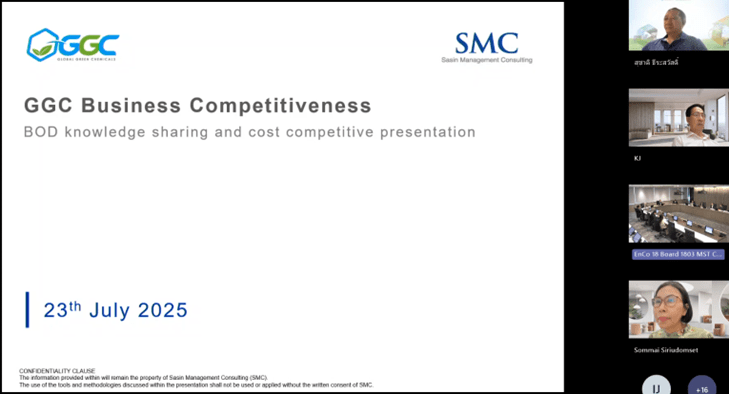
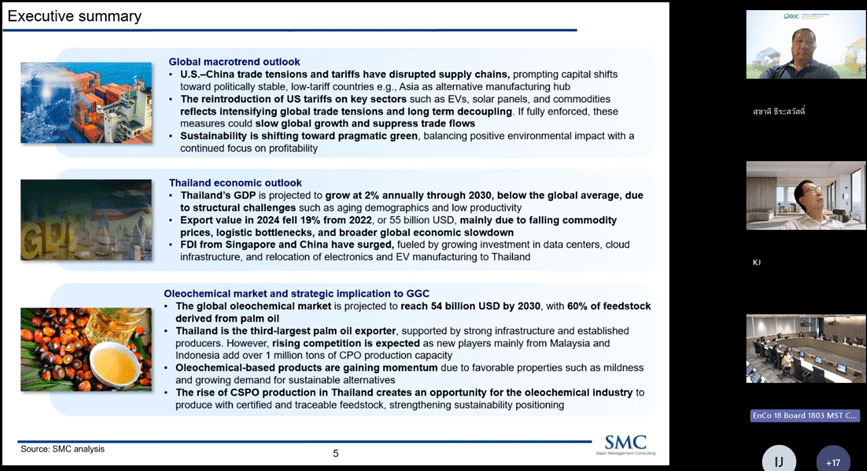
GGC organized the training program “Economics Outlook and Cost Competitiveness” in collaboration with Sasin Graduate Institute of Business Administration of Chulalongkorn University. The objective was to provide useful insights into global economic trends and issues related to GGC Cost Competitiveness to support strategic decision-making for GGC’s business direction.
The training covered the following topics:
- Global Economic Outlook – An overview of both global and domestic economic conditions, including key factors that may affect the overall economy.
- Cost Competitiveness – An overview of market conditions for GGC’s products and indicative production cost structures of producers operating in the same markets.
Outcomes and Benefits
- The Board gained a clearer understanding of market trends for GGC’s products and was better equipped to define GGC’s strategic direction.
- All 11 directors and senior executives of GGC participated in the session.
Navigating Change in Sustainability Landscape
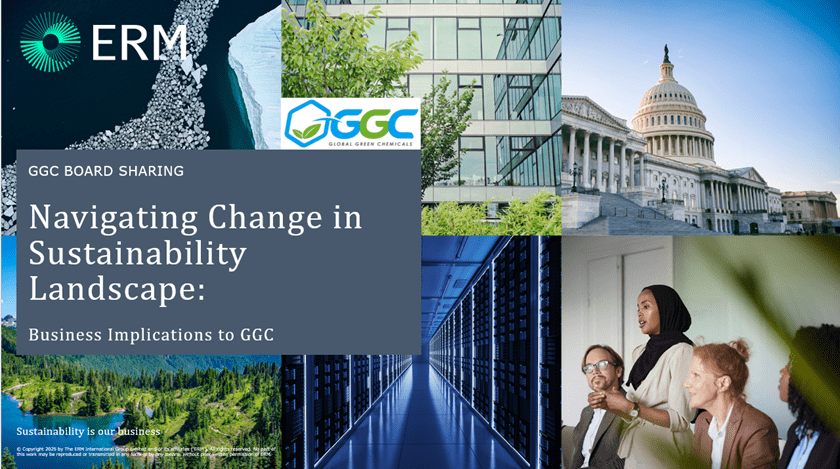
Given the growing significance of sustainability-related risks and issues in business operations in Thailand and globally, GGC organized the “Navigating Change in Sustainability Landscape” training program for the Board of Directors. The objective was to build knowledge, understanding, and awareness of sustainability topics to support informed decision-making on key business matters and to help GGC capture opportunities that drive sustainable growth.
The training covered the following topics:
- Sustainability & Transition – Consideration of risks and opportunities associated with the transition toward a low-carbon economy, and key sustainability issues that the private sector should prioritize.
- Product and Supply Chain Sustainability Policies – Discussions on sustainable Supply Chain development, including responsible management across the Supply Chain and capacity-building for Suppliers and Stakeholders.
- Key Developments in Sustainability Disclosure – Key requirements for sustainability disclosure under national and international standards to enhance Stakeholder confidence and drive sustainable business practices.
Outcomes and Benefits
- The Board and executives enhanced their understanding of sustainability issues and were better able to determine GGC’s strategic direction.
- All 11 directors and senior executives of GGC participated in the session.
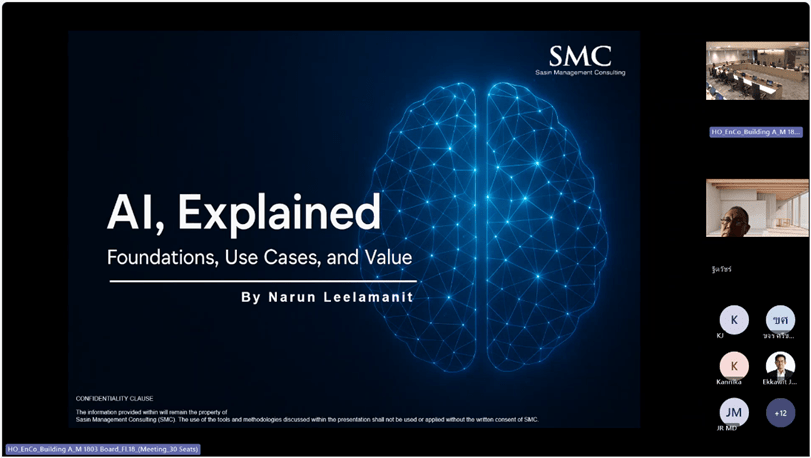
AI, Explained– Foundation, Use Cases, and Value
GGC organized the “AI, Explained – Foundation, Use Cases, and Value” training program, in collaboration with Sasin Graduate Institute of Business Administration of Chulalongkorn University, to provide an overview of trends in Artificial Intelligence (AI) adoption and key considerations in applying AI in business operations.
The training covered the following topics:
- AI Adoption Trends in Various Industries – How AI is being used across different sectors.
- Business Paradigm Shifts Driven by AI – Changes in business models and work processes as AI becomes more integrated into operations.
- Business Opportunities and Key Considerations in AI Adoption – Opportunities for value creation and important risk and governance considerations when integrating AI into processes
Outcomes and Benefits
- The Board gained insights into AI technology trends and potential applications in GGC’s industries.
- All 11 directors and senior executives of GGC participated in the session.
Board of Directors’ Performance Evaluation GRI 2-18 (2021)
GGC evaluates the performance of the Board of Directors annually. To ensure an accurate and comprehensive assessment, GGC divides the evaluation into three types: (1) Board Evaluation (Overall Assessment), (2) Individual Director Self-Assessment, and (3) Peer Evaluation (Cross-Assessment). All three assessment types use indicators that are aligned with good practices and the Principles of Good Corporate Governance for Listed Companies 2017 (CG Code) issued by the SEC. In 2025, the assessment results of the Board of Directors were as follows: overall assessment at 96.97%, self-assessment at 95% and cross-assessment at 96.15%.
In this regard, in the event that executives perform their defects or dishonesty, GGC may claim damages and benefits received from such executives in accordance with the Clawback Provision under Section 85 of the Public Limited Companies Act B.E. 2535 and Sections 89/7 and 281/2 of the Securities and Exchange Act B.E. 2535, as amended in 2008. Executives may be subject to both civil and criminal liabilities.

Board of Directors Liability Process
In accordance with the Regulation on Directors' and Executives' Liability Protection B.E. 2559 (2016), the Company recognizes the importance of corporate governance in today's complex and highly competitive business environment, where directors and executives must perform their duties in compliance with applicable laws, regulations, and resolutions, with integrity and in the best interests of the company. However, even when such actions are taken within the proper framework and with genuine intent to benefit the company, they may still affect the interests of stakeholders and potentially expose directors or executives to personal liability claims. Therefore, the Company stipulates that there is no limitation on the liabilities of directors and executives in respect of any act or omission by a director or executive in the performance of, or in connection with, their duties, or in holding the position of director or executive, and directors and executives are required to perform their duties with care, prudence, and accountability as those responsible for setting the direction of the organization.
Shareholder Structure and Voting Rights
GGC emphasizes equality among shareholders. Each share carries one voting right (one vote per one share), and no Golden Shares or Dual Class Shares are offered to any shareholder under any circumstances. In the event that shareholders hold Non-Voting Depository Receipts (NVDR), they have no voting rights at the Shareholders’ Meeting, except in the case of voting on the delisting of GGC’s shares from the Stock Exchange of Thailand.
Details regarding the voting requirements at the Shareholders’ Meeting can be found in GGC’s Articles of Association concerning Shareholders’ Meetings and Voting Procedures.
For additional information on GGC’s shareholder structure and voting rights: Major Shareholders
In addition, if GGC proposes any material changes in business operations or policies, such matters must be presented to shareholders for voting, allowing shareholders to express their views and intentions. The board of directors shall operate the Company’s business, under the supervision of the shareholders meeting and in accordance with the provisions of the Articles of Association. GGC promotes and supports the full exercise of shareholder rights, including: fundamental rights under applicable laws, the right to receive material information, the right to propose agenda items and nominate candidates for directorship, the right to submit questions in advance, and the right to attend and vote at the Shareholders’ Meeting.
The election and removal of the Board of Directors by shareholders represent a key governance mechanism, ensuring that any changes to the Company's governing body are subject to shareholder approval through the Shareholders' Meeting.
The shareholders meeting shall elect the Board of Directors to operate the Company’s business, under the supervision of the shareholders’ meeting and in accordance with the provisions of these Articles of Association. It is not required that directors be the shareholders of the Company. The Company’s Board of Directors shall be elected or removed by the shareholders meeting and shall consist of not less than five (5) directors, but not more than fifteen (15) directors, and not less than one-third (1/3) of the total number of directors shall be independent directors, which shall be no less than three (3) directors; provided that not less than half (1/2) of all directors shall have residence in the Kingdom of Thailand. All of the Company’s directors shall have the qualifications and shall not possess prohibited characteristics as prescribed by laws. The independent directors shall at least have the qualifications in accordance with the criteria or requirements under the law on securities and exchange. GGC continuously improves the mechanisms that support these rights to ensure maximum benefit to shareholders.
Details regarding the voting requirements at the Shareholders’ Meeting can be found in the Articles of Association concerning Shareholders’ Meetings and Voting Procedures, available at: The Company’s Articles of Association regarding the Shareholders Meeting and Vote Casting, Articles of Association
Securities Holding
Holding GGC’s securities helps motivate executives to perform and drive GGC toward its goals, while strengthening their long-term commitment to GGC. GGC has therefore established good practices on the holding and trading of securities for the Board of Directors and executives, including a prohibition on disclosing inside information to the public for personal benefit, in line with the Securities and Exchange Act B.E. 2535, as well as the guidelines of the Stock Exchange of Thailand and the Office of the Securities and Exchange Commission (SEC).
The number of shares held by the Managing Director and senior executives as of 31 December 2025 is shown in the table below:
Securities holding by executives of GGC, spouses, and minor children
| Securities Holder | Number of Shares Held (Shares) |
|---|---|
| 1. Mr. Krisada Prasertsukho | None |
| 2. Mr. Teerasak Na Chiangmai | None |
| 3. Mr. Piya Suri | None |
| 4. Ms. Pronsook Limsathit1 | N/A |
| 5. Mrs. Boodsada Seema | None |
| 6. Ms. Pakawan Kamonchaivanich | None |
| 7. Mr. Jiruss Rianchaiwanich | None |
| 8. Mr. Sutthisarn Khongaphirak | None |
| 9. Mr. Ekaphong Govitgoongrai | None |
| 10. Ms. Tanyarut Boontheekul | None |
| 11. Mr. Kawin Kaewkong | None |
| 12. Mr. Suwit Chongkasemwong | None |
| 13. Mr. Thodsaphorn Phienchob | None |
| 14. Ms. Chompunuch Liamprawat | None |
| 15. Mr. Promporn Isarangkun Na Ayutthaya | 2,000 |
| 16. Mr. Anupong Phitukpong2 | N/A |
| 17. Mr. Chanasiri Vanit | 3,000 |
| 18. Mr. Suchet Deemangmee | None |
| 19. Mr. Jakkrit Rungsimanop | None |
Remark:
(1) Ms. Pornsook Limsathit was appointed as Vice President, Corporate Finance and Accounting, replacing Mr. Jittasak Soonthornpan, effective from May 16, 2025.
(2) Mr. Anupong Phitukpong was appointed as Vice President, Reporting to Managing Director, replacing Mrs. Wacharee Hanwongpaiboon, effective from February 1, 2025.
GGC Stock Retention and Ownership Guideline
GGC has established share ownership guidelines for the Managing Director and senior executives to encourage them to hold GGC shares while in office, thereby reinforcing long-term alignment with shareholders and promoting sustainable value creation. These guidelines are intended to ensure that executives gradually increase their shareholding and share in the long-term performance of GGC
| Position | Multiple of Annual Base Salary |
|---|---|
| Managing Director | 10 |
| Senior Executives | 5 |
For additional information on the Managing Director and senior executives: One Report 2025
| Position | Name - Last Name | Multiple of Annual Fixed Salary |
|---|---|---|
| Managing Director | Mr. Krisada Prasertsuko | 0 |
| Executive Committee | Mr. Phromphron Isarankura Na Ayutthaya Mr. Chanasiri Vanit |
0.0085 |
Management Remuneration GRI 2-21 (2021)
The remuneration of the Managing Director is determined appropriately based on clear, transparent, fair, and reasonable criteria, taking into account duties, responsibilities, and performance. GGC evaluates the performance of the Managing Director and senior executives annually according to key performance indicators (KPIs), which include financial metrics (such as EBITDA, net profit, and return on invested capital (ROIC)), performance against long-term strategic objectives, operating performance (Operating Income), and overall company performance. GGC also considers Relative Financial Metrics (such as Tobin’s Q/Q), the scope of responsibilities, leadership and talent development, and overall economic conditions. The evaluation results influence both short-term and long-term remuneration of the Managing Director and senior management. Short-term compensation consists of salary, bonus, and other benefits. In 2025, the Managing Director received total annual remuneration of 8,629,550.65 Baht
GGC discloses the fixed and variable remuneration of the Managing Director and senior management as shown in the table below:
| Executive Compensation for 2024 | Executive | |
|---|---|---|
| Managing Director1 | Executives as defined by SEC (Excluding Managing Director)2 |
|
| Salary (THB) | 6,257,076 | 67,890,533.75 |
| Bonus (THB) | 1,433,913.25 | 16,444,704.22 |
| Provident Fund (THB) | 938,561.40 | 6,303,820.60 |
| Total (THB) | 8,629,550.65 | 90,639,058.57 |
Remarks:
(1) Mr. Kridsada Prasertsuko, for his service as Managing Director from January 1 to December 31, 2025.
(2) The number of Executives under the SEC’s definition (excluding the Managing Director): 21.
(3) GGC made contributions to the provident fund at rates ranging from 5% to 15% of executives’ salaries.
Furthermore, GGC has disclosed the average and median annual remuneration of all Employees and the ratio between such remuneration and the Managing Director’s annual compensation, as shown in the table below:
| Employee Compensation (THB) | Median | Average |
|---|---|---|
| Median/average of all employees’ annual remuneration, except MD | 1,204,160.54 | 1,492,027.51 |
| Ratio of average or median of employee remuneration and MD annual compensation | 6.66 | 5.38 |
For additional information on the Board of Directors and GGC’s performance related to the Board such as the determination of shareholder voting rights and executive remuneration: One Report 2025